In Search of the Truth About Core Web Vitals

Translated from the original Spanish article.
Ever since Google rolled out Core Web Vitals in June 2021, many brands have come to us wanting to improve the technical performance of their corporate website, particularly on these metrics. But how much are they really worth? Let's take a look.
In Search of the Truth About Core Web Vitals.
Ever since Google rolled out Core Web Vitals in June 2021, many brands have come to us wanting to improve the technical performance of their corporate website, particularly on these metrics.
And most of them are surprised by what we tell them. That's why we've decided to tackle the subject in an article that is strategic rather than technical, with the aim of shedding some light and helping marketing leaders make informed decisions, especially at companies that want, or already have, a strong digital presence.
We'll cover the most common frustrations marketing leaders experience with Core Web Vitals and offer a clearer, more detailed perspective to help them resolve their concerns.
We'll also look at how much these metrics actually affect Google rankings. We'll highlight how many companies often fail to approach the issue properly, missing its essence or the real heart of the problem.
To illustrate the point, we'll present case studies where a focus on Core Web Vitals has had a positive impact on different companies' business metrics.
Finally, we'll set out how to successfully build a strategy for improving and optimising your website.
The frustration of marketing directors
A few months ago, we received an email from a brand that had been referred to us directly. Their request was clear: "our site is built on Webflow and we need to improve our Core Web Vitals". That same day, their head of marketing explained to us on a video call that they had a technical SEO audit carried out by an external agency and needed to implement a long list of changes to their website.
— Right. Could you tell me what the strategic goal behind working on Core Web Vitals is?
Don't get me wrong: we found the audit professional and well grounded. The proposed actions were legitimate and properly framed. However, after reviewing the client's website, we identified areas for improvement in the site architecture. And although the performance metrics weren't poor, we spotted certain elements that, with minimal intervention, could significantly affect LCP, a metric closely tied to loading speed and, within Core Web Vitals, the one most closely correlated with rankings and user experience, as we'll discuss later.
Among other things, we noticed that the content on the transactional pages wasn't optimised for either SEO or conversion (in this case, lead generation). The content was convoluted, full of internal jargon and far too focused on the brand, pushing into the background what potential customers would actually get from hiring them.
— It's to improve our Google rankings. Honestly, I don't have all the details, as this isn't my area of expertise. What we did was commission an audit from an agency we'd heard very good things about.
Our duty and responsibility is to advise clients whenever we feel we can contribute something positive to their decision-making. So we put on our consultant hats and explained that we would quote for those changes, but that we didn't believe that was what would get them ranking on Google. And we explained why.
In the end, we suggested putting together a report in which, on the one hand, we would estimate the hours needed to carry out the task list as requested and, on the other, after an analysis, we would present a detailed plan with a prioritised selection from the full list of changes, along with other elements of the site that could be worked on to have a greater impact on business metrics.
The report's findings were as follows:
We estimated that carrying out the audit's full list of technical tasks would take around 170 hours of work on the site. That estimate had a margin of error, as some tasks involved a level of complexity and uncertainty that was hard to estimate, not least because we hadn't built the site ourselves and it carried considerable technical debt.
In addition, we presented the prioritised plan. Alongside a handful of priority technical tasks, it included a reworking of the site architecture with simpler, more intuitive and better-organised logic for both users and Google, a revised narrative and a UX redesign proposal for the main transactional pages, plus SEO copy optimisation focused on the queries that genuinely belonged to their target audience. With a total estimate of between 90 and 120 hours.
In other words, a cheaper and faster plan designed to have the greatest impact relative to effort.
The client appreciated the suggestion and decided to go down that route. Within just a few months, the changes had a direct impact not only on their Google positions (for both existing and new relevant keywords), but also on user retention (session duration and pages per session) and on the conversion rate of the transactional pages (leads generated per 100 visits).
In other words, they started getting a greater, more tangible financial return from their SEO and paid efforts.
In our experience, companies (or marketing directors) get frustrated with Core Web Vitals mainly in two situations:
Situation 1:
They've commissioned an SEO audit that flags an endless list of things to fix and many Core Web Vitals-related actions without any prioritisation, that is, all given the same level of importance. Carrying out these actions inevitably means a large investment, not only of money but above all of time and resources.
In many of these cases, through misinformation or poor advice, they believe their SEO strategy isn't working because they don't have high scores on these metrics.
Situation 2:
They struggle to make a convincing, reasoned case to management or stakeholders for investing in this area of the website. They've heard or read all sorts of professional opinions on how important Core Web Vitals are and don't know how to approach it. In the end, more often than not, it all comes down to "we have to do it because it's important for SEO".
In the rest of this article we'll try to give them a hand with both situations.
How much Core Web Vitals really affect Google rankings
I'm sure what I'm about to say will raise more than a few sceptical eyebrows, but I'll say it plainly anyway: in most cases they don't make much difference.
But let's unpack that a little, because they do play an important role on our website and they also have an impact on its ranking potential on Google.
The truth is that, for some years now, Google has included CWV among its ranking factors, which means they directly influence how a page performs in the results for a query. 2026 update: since 12 March 2024, the Core Web Vitals have been LCP (loading), INP (interactivity, which replaced FID) and CLS (visual stability). To count as good, Google asks for an LCP of 2.5 s or less, an INP of 200 ms or less and a CLS of 0.1 or less, measured at the 75th percentile of real visits.
Here's what Google tells us:
"We recommend site owners achieve good Core Web Vitals for success with Search and to ensure a great user experience generally. However, great page experience involves more than Core Web Vitals. Good stats within the Core Web Vitals report in Search Console or third-party Core Web Vitals reports don't guarantee good rankings.
How important is page experience to ranking success?
Google Search always seeks to show the most relevant content, even if the page experience is sub-par. But for many queries, there is lots of helpful content available. Having a great page experience can contribute to success in Search, in such cases."
And this message, which we'll interpret, is the same one they've maintained in recent years.
John Mueller, Google Search Advocate, confirmed that, although web vitals affect rankings, relevance also plays an important role. If website A is faster than website B but B is more relevant to the user's search query, website B would still rank higher than A.
Mueller also pointed out that websites moving from "needs improvement" to "good" may see ranking improvements. But websites that are already good and improve their speed by a millisecond or two may not see any change in position.
So we can draw two clear conclusions:
- Google's main intention is to show the most valuable or relevant content for its users' searches. So it makes sense that if one piece of content is better than another, Google won't stop showing it simply because its performance metrics are worse.
- Core Web Vitals penalise more than they reward. In other words, considerably poor metrics will damage a website's ranking potential, whereas very good metrics won't necessarily make any difference to its Google results.
These conclusions match the results Google itself published a month after adding Core Web Vitals to its algorithm.
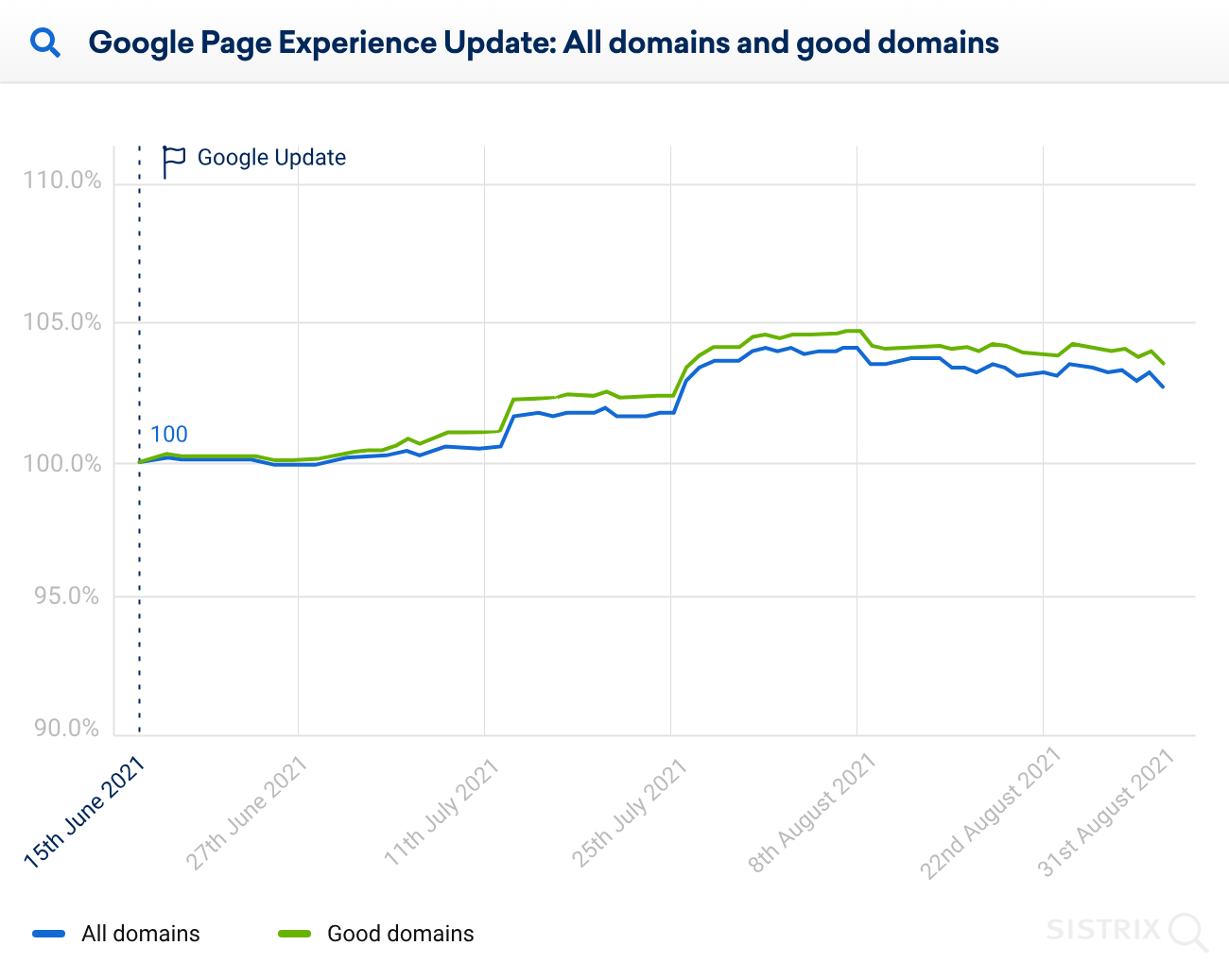
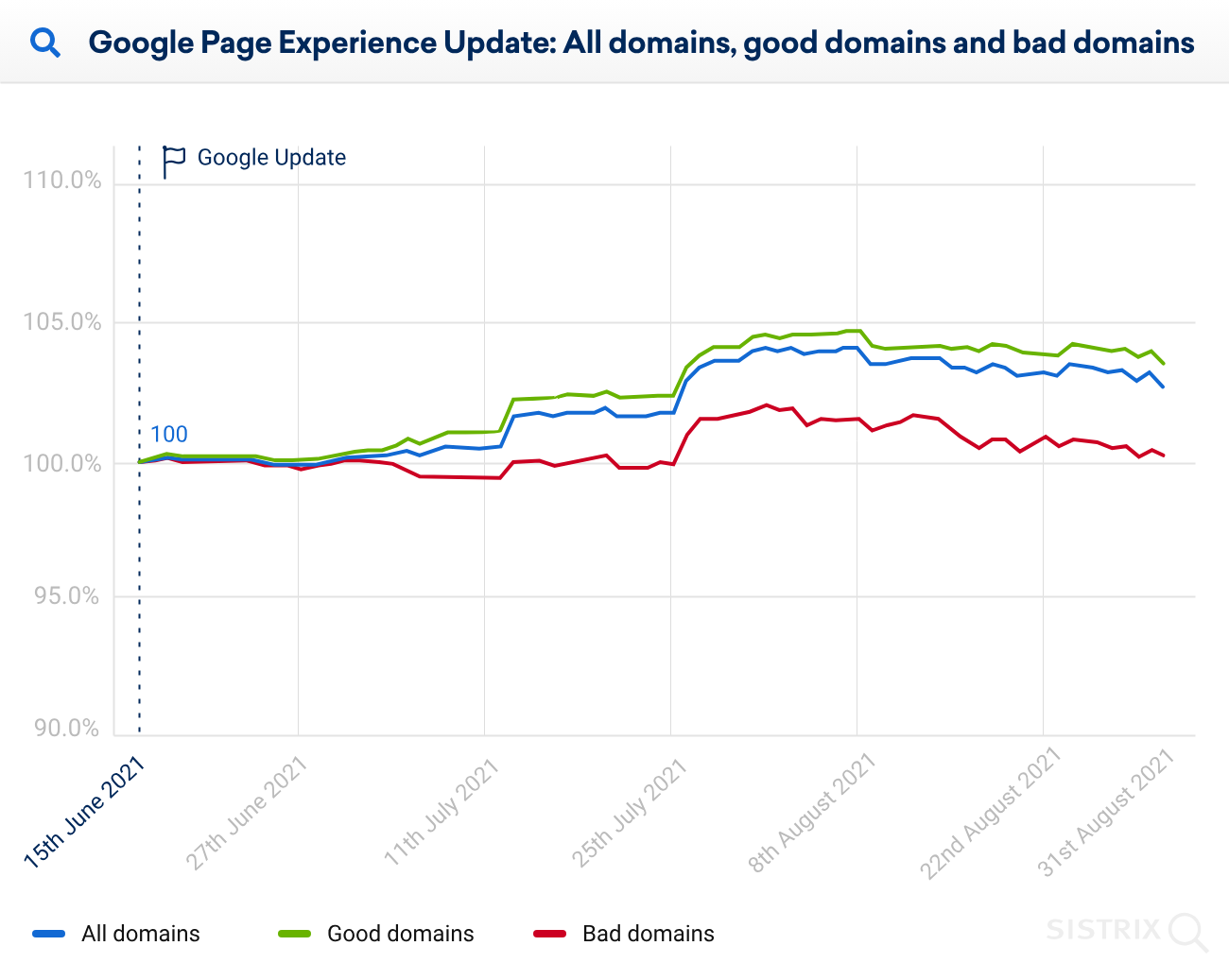
But let's look at the conclusions of this independent study of 3 million pages ranking in Google's top 20 results.
Here's what we can take from the study:
- There is a correlation between a higher position in the results and a better LCP score
- Only 39% of the pages analysed passed the Core Web Vitals assessment - Results vary widely by sector and competition
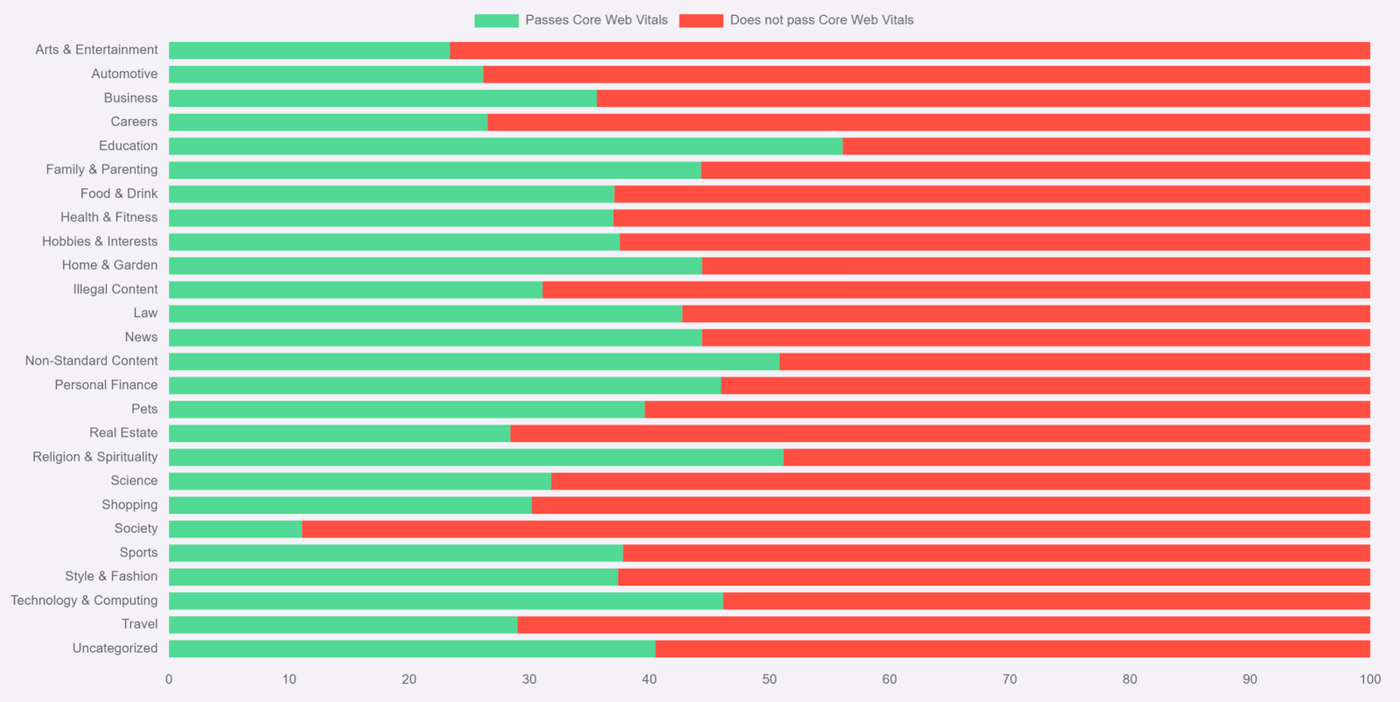
Percentage of pages passing Core Web Vitals on desktop (by industry)
There are other studies with slightly different results, but the conclusions are the same, and they match what we already know: Core Web Vitals won't, per se, get you into Google's top positions.
The reality is that their importance is fairly relative, if we stick strictly to a website's ability to rank on Google on the strength of its technical aspects.
But the key point in all this is that website optimisation is usually assessed from the wrong angle.
The key isn't Google, it's the user
Google's main intention is to show the most valuable or relevant content for its users' searches, along with the best possible experience.
If we want to rank organically on Google, we need to focus on understanding our users: what their search intent is, where they are in their journey when they reach our site, and how we can give them the most useful content for their circumstances.
But that's not all. We also need to think about how we can offer them the best possible browsing experience. That means good loading and response times, an intuitive layout of information and elements, and a logical, effective navigation.
If we take these two aspects, content and experience, and look at them through our users' eyes, we'll know how to make the right decisions to substantially improve the results of our work in the online channel.
Let's picture it more vividly.
Imagine you're walking through an unfamiliar city to get to an important meeting. You go down different streets, squares and avenues. But at certain points the pavement ends and you have to turn back and take another route. The signs are hidden and confusing. There are pedestrian lights that take forever to change, and you run into unexpected roadworks diversions that throw you off course.
All these inconveniences interrupt your progress towards your destination, raise your stress levels and make for an unpleasant experience.
People browsing the web are also on a journey, where every action is a step in what would ideally be a continuous flow. And, just as in real life, they can be interrupted by delays, confused by information and led into making mistakes. These events can lead to resignation and to abandoning a site.
In both scenarios, the best decision is to identify and remove interruptions and obstacles to allow for a pleasant journey and, as a result, satisfied users.
Success stories in business metrics
From a user-centred perspective, by working on their Core Web Vitals many companies have achieved, and continue to achieve, excellent results in their online business metrics. Let's look at some examples:
Vodafone
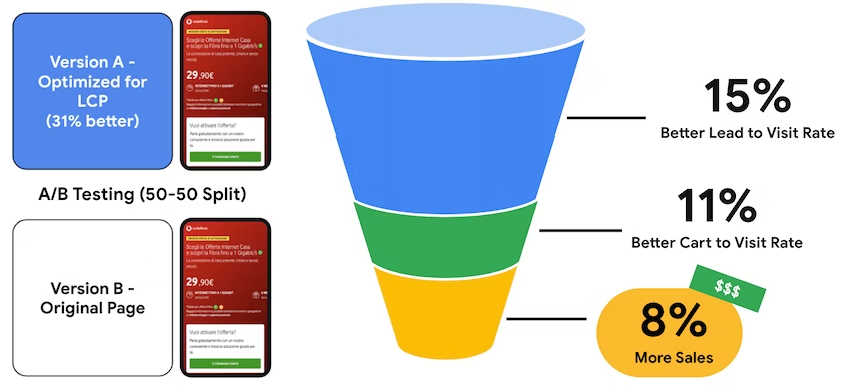
Vodafone (Italy) improved LCP by 31% and increased sales by 8%.
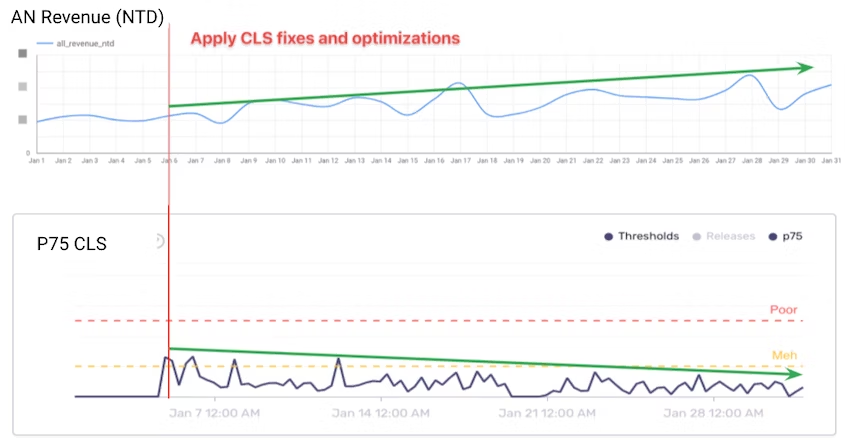
iCook
iCook improved CLS by 15% and increased ad revenue by 10%.
Tokopedia
Tokopedia improved LCP by 55% and increased average session duration by 23%.

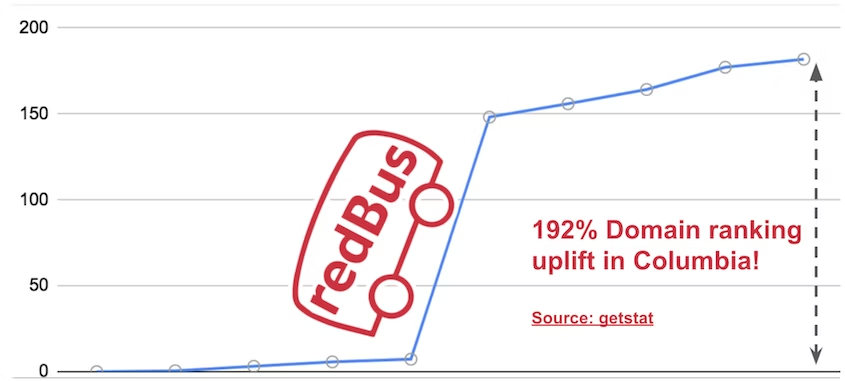
redBus
Core Web Vitals fixes contributed to 80-100% mobile conversion rates (mCVR) and a significant increase in domain ranking across all of redBus's global market properties.
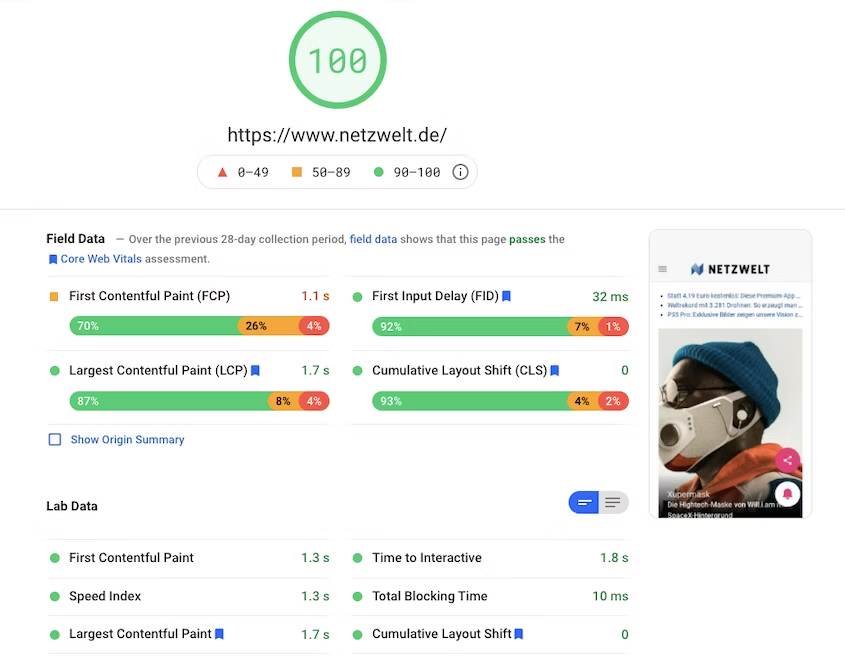
Netzwelt
Core Web Vitals fixes increased the site's ad revenue by 18%.
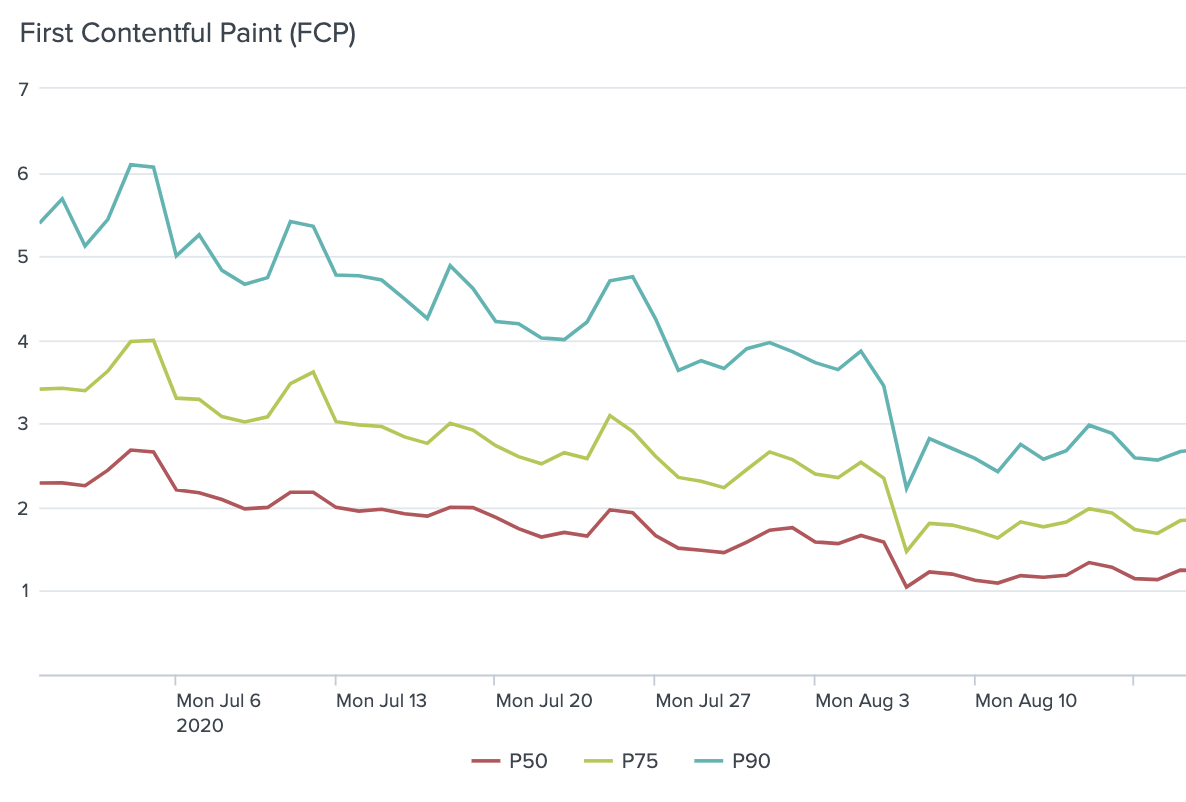
Yelp
Optimising FCP boosted web conversions by 15%.
As we can see, the results of improving the user experience don't necessarily show up in Google rankings, but in the business performance our website delivers.
How to approach Core Web Vitals from a strategic perspective
We should bear in mind that it's always best to build this work into the website's design and development process from the start and make sure we have a product that meets these requirements. But if it's too late and we're dealing with a site that isn't performing as we'd like, there are several points that will help us tackle it:
1. See it in a strategic context
The most important thing is to consider a website's performance within the context of a broader strategy. Resources are limited: your technical people (SEOs / designers / developers / Webflow specialists) are finite and have a set number of hours available to work.
So we need to keep in mind which other areas this allocation of resources might be competing with. Areas such as:
- Website architecture
- UX/UI design
- Narrative and copywriting
- Content plan
- Product development (front-end development)
All of them can have an impact on the business, so the rest of the assessment is best made in relative terms, or in terms of opportunity cost: how much it's worth devoting resources to performance rather than to another area.
2. Assess the impact of Core Web Vitals work
The next step is to assess what impact CWV are really having on the performance of our online channel. We should see this optimisation work as a long-term investment in our website that will give a boost to any subsequent action or strategy we plan. So it's worth asking whether a website redesign is on the horizon, in which case the smartest move is usually to factor it into that new product.
If not, we should always focus on the metrics that are genuinely poor, and do so from a user-centred perspective. Which ones might be hurting their experience the most?
As we saw earlier, when the metrics are already good, even if they could be better, optimising them won't have much impact on our results.
3. Prioritise with a business mindset
Google essentially evaluates page performance on a page-by-page basis, although it may take some site-wide aspects into account.
So it always makes sense to focus on and prioritise the pages with the greatest value for the website's ROI: the most sensitive ones, or those that matter most in the user's buying cycle.
To put it more concretely, we might prioritise a landing page, or a transactional SEO page, over the corporate "About us" page or even the home page.
Every case is different, but it's advisable to go through this assessment exercise when making decisions.
4. Take technical debt into account
If a website doesn't meet certain performance standards, it's likely carrying bad practices from its design and especially from its development.
This is known as technical debt: failing to be precise or rigorous in applying quality standards when building a product makes any later work on it more expensive, and the team responsible will be forced to redo much of what isn't visible on the site, such as its structure, class system or code efficiency.
We've sometimes seen projects where it was more cost-effective to start a website from scratch than to fix an existing product.
Turn to a team with experience and strategic vision
If you need advice on tackling the performance or technical optimisation of a website, our recommendation is to turn to a consulting team with strategic vision, one that brings perspective and doesn't stop at a technical analysis of the situation.
If you're a mid-market company keen to get more out of your online channel, our team can help you design the digital strategy to make it happen.